
UPC-Court of First Instance: Substantive decision on a claim construction
April 7, 2026
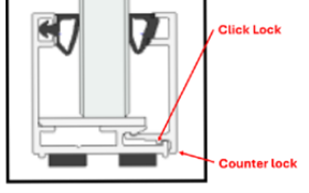
The patent protects a glazing system comprising two aluminum profiles that create a secure space for holding the glass panel in place. The profiles feature a self-locking mechanism, wherein a grooved rubber beading positioned between the glass panel and the profiles generates external forces that push them apart, wherein these profiles have curved hooking parts designed such that the turning movements generated by the external forces, as well as the external forces at the pivot point, compress the locking mechanism to further tighten the locking mechanism and thereby arrest the glass panel in its position. The interpretation of the feature “turning movements” is particularly disputed, namely whether these must be caused both by the claimed “external forces” and by “external forces” at the pivot point. The defendant argues that “turning movement” should be understood as a movement, i.e., a motion, and not merely as a “turning moment,” i.e., a torque (a force). The court concurs with the defendant’s view that the person skilled in the art interprets “turning movements” as implying an actual movement. This follows from the fact that both “turning movement” and “turning moment” are mentioned in the specification. The skilled person thus recognizes that the use of the term “turning movement” in the claim represents a deliberate choice of “movement” rather than “moment.” Furthermore, the effect of the rotation — namely, the “further tensioning” of the locking mechanism — also points to a movement caused by forces and not merely to a torque/moment.
The skilled person also understands that, due to the fixed position of the female profile, an outward-directed force on the upper leg of the female profile may indeed generate a moment or torque at the lower part of the female profile, but this does not result in a movement as required by the claim. However, in the contested items, further movement and further tightening of the self-locking system are not possible, as this is prevented by the lower lug of the male profile, which is designated as “counter clock” in the drawings. Therefore, there is no infringement (LK Den Haag, 29.8.2025, CFI 455/2024, CFI 684/2024).